The Suffering of Education in Taiz: Administrative Corruption Threatens Children’s Future

The Suffering of Education in Taiz: Administrative Corruption Threatens Children’s Future
Report : Raafat Al-Hammadi
The education sector in Yemen is witnessing a severe decline due to years of conflict and economic and humanitarian crises, depriving millions of children of their right to education or forcing them to study under harsh conditions lacking the most basic necessities. Taiz governorate stands as a stark example of this reality, where challenges are compounded by overcrowding, a shortage of teaching staff, weak infrastructure, and administrative dysfunction that further complicates the situation—threatening the future of an entire generation and putting the education system under serious strain.
Amid difficult humanitarian and living conditions, the village of “Al-Haz Aseeda,” located in Quds sub-district of Al-Mawaset district in Taiz, is facing a severe educational crisis caused by administrative practices described by residents as “arbitrary” and “corrupt,” threatening to deprive their children of their fundamental right to education. Appeals from residents, received by the report’s author, reveal a troubling picture of administrative corruption and collusion by local officials, who have disregarded directives issued by higher authorities—undermining state institutions and jeopardizing children’s futures.
Denial of School Enrollment and Violent Actions
Residents of “Al-Haz Aseeda” village confirm that the district’s Director of the Education Office, Abdulhafiz Al-Munifi, refuses to admit their children into local schools, ignoring directives issued by higher authorities. According to residents, this systematic refusal is part of a broader pattern of administrative corruption affecting the district.
The crisis escalated with a serious development when the district’s Director General and head of the local council, Abduljalil Gharsan Al-Hammadi, ordered the closure of Martyr Zayed Sultan School in the village. The school supervisor appointed by the governorate’s Education Office, Mr. Abdullah Hizam, was forcibly detained and compelled to hand over the school’s official stamp under pressure. This closure, described by residents as “thuggery,” occurred despite explicit instructions from the Director of the Education Office in Taiz, Mr. Abdulwasea Shaddad, to resolve the issue through legal means.
The Education Battle: Systematic Deprivation and Community Resistance
Martyr Zayed Sultan School in Al-Haz (Aseeda) remained closed for more than fifteen years before being officially reopened in the 2023/2024 academic year through the efforts of the Taiz Education Office, attended by both the governorate and district education directors. Despite the appointment of a school supervisor, entrenched hostility from district officials—particularly the Education Office Director Abdulhafiz Al-Munifi, supported by Deputy Governor Khaled Abduljalil—has persisted.
Manifestations of deprivation include the lack of textbooks, classroom furniture, and essential services, in addition to withholding salaries from contracted teachers previously funded by organizations. The situation has worsened in the new academic year, with both students and teachers facing ongoing harassment.
In response to this deliberate neglect, villagers and the community council have shown remarkable resilience by purchasing textbooks at their own expense and hiring contracted teachers funded by the parents’ council. This determination reflects their firm belief in their children’s right to a better future despite the challenges.
Obstruction of Student Registration and Disregard for Higher Directives
Abusive practices have extended beyond depriving the school of basic resources to issuing directives to nearby school principals in Al-Mawaset district not to accept sixth-grade graduates from Martyr Zayed Sultan Basic School into seventh grade. This unjust decision ignores the fact that the governorate’s Education Office officially opened the school and approved its results and certificates centrally after the district office refused to do so.
Despite directives from the Speaker of Parliament, Sheikh Sultan Al-Barakani, and the Director General of the Education Office in Taiz, Mr. Abdulwasea Shaddad, to resolve the issue and accept the students, these orders have been completely ignored by district officials. Notably, students have been forced to enroll in schools outside the governorate, such as in Sana’a and neighboring districts like Al-Ma’afer and Al-Shamaytain, while being obstructed within their own district.
Abduction of School Supervisor and Abuse of Power
One of the darkest aspects of this case involves the district director ordering the closure of the school, appointing a local individual to act as school principal, and preventing the official principal from entering. This unlawful act constitutes a blatant violation of teachers’ rights and an assault on the integrity of educational institutions. Residents affirm that the targeted teacher has no links to terrorism and that his removal in such a manner raises serious questions about the motives behind these actions—whether political, partisan, or driven by personal interests.
Harsh Reality at Martyr Zayed Sultan School
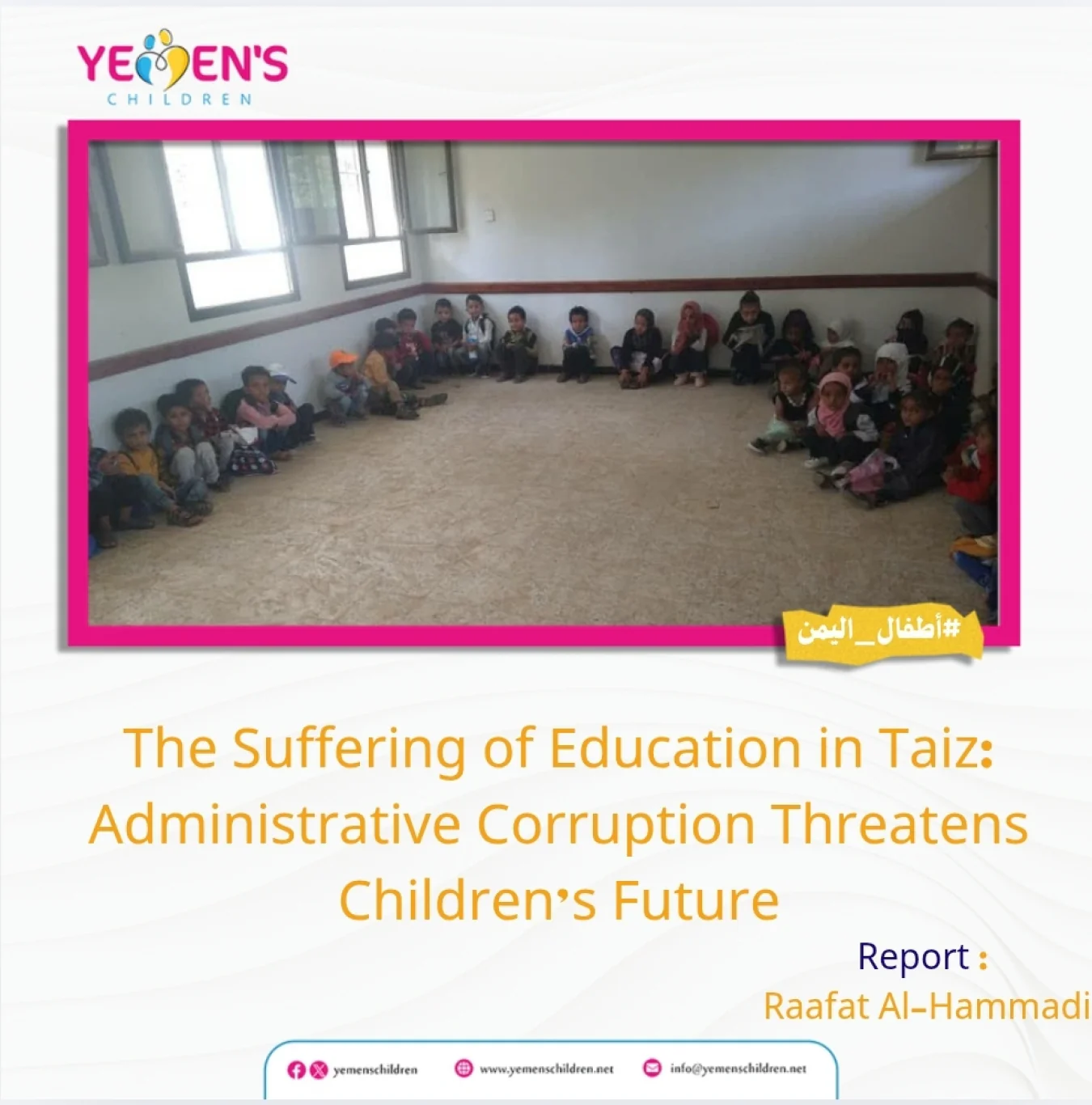
A field visit by the report’s author to Martyr Zayed Sultan School in Quds sub-district reveals a grim reality: dozens of students sit on cold classroom floors due to a lack of desks. A volunteer educator confirmed that many classrooms suffer from a severe shortage of seating, negatively affecting students’ academic performance.
Despite promises made by the Director General of the Education Office in Taiz during the school’s reopening to provide school bags, textbooks, and furniture, these commitments have not been fully met. Only 120 school bags were distributed out of 150, while the district obstructed the delivery of 50 chairs pledged by the district education office and 150 chairs from the projects department. This systematic deprivation has forced the parents’ council to hire volunteer teachers, pay their salaries, and procure textbooks from other governorates to meet the school’s needs.
Call for Help and Demands for Justice
Residents of “Al-Haz Aseeda” village call on all conscientious individuals and government officials to intervene and ensure justice for these students, granting them their full rights like other students and compensating them for the deprivation they have endured in past years. They affirm their determination to take legal action against anyone responsible for obstructing the educational process, directly or indirectly.
Residents strongly condemn the district director’s actions in closing the school and preventing the principal from performing his duties, demanding accountability for those responsible for these violations. They confirm that all documents and evidence supporting these claims are preserved and ready to be submitted to the relevant authorities.
This case is not merely an administrative dispute but a distress call from a community striving to secure its children’s future in the face of widespread administrative corruption—requiring urgent and decisive intervention at the highest levels to safeguard the right to education for Yemen’s children.