When Children Become Offerings for Apology

Report by Mohammed Jamal Al-Tayyari
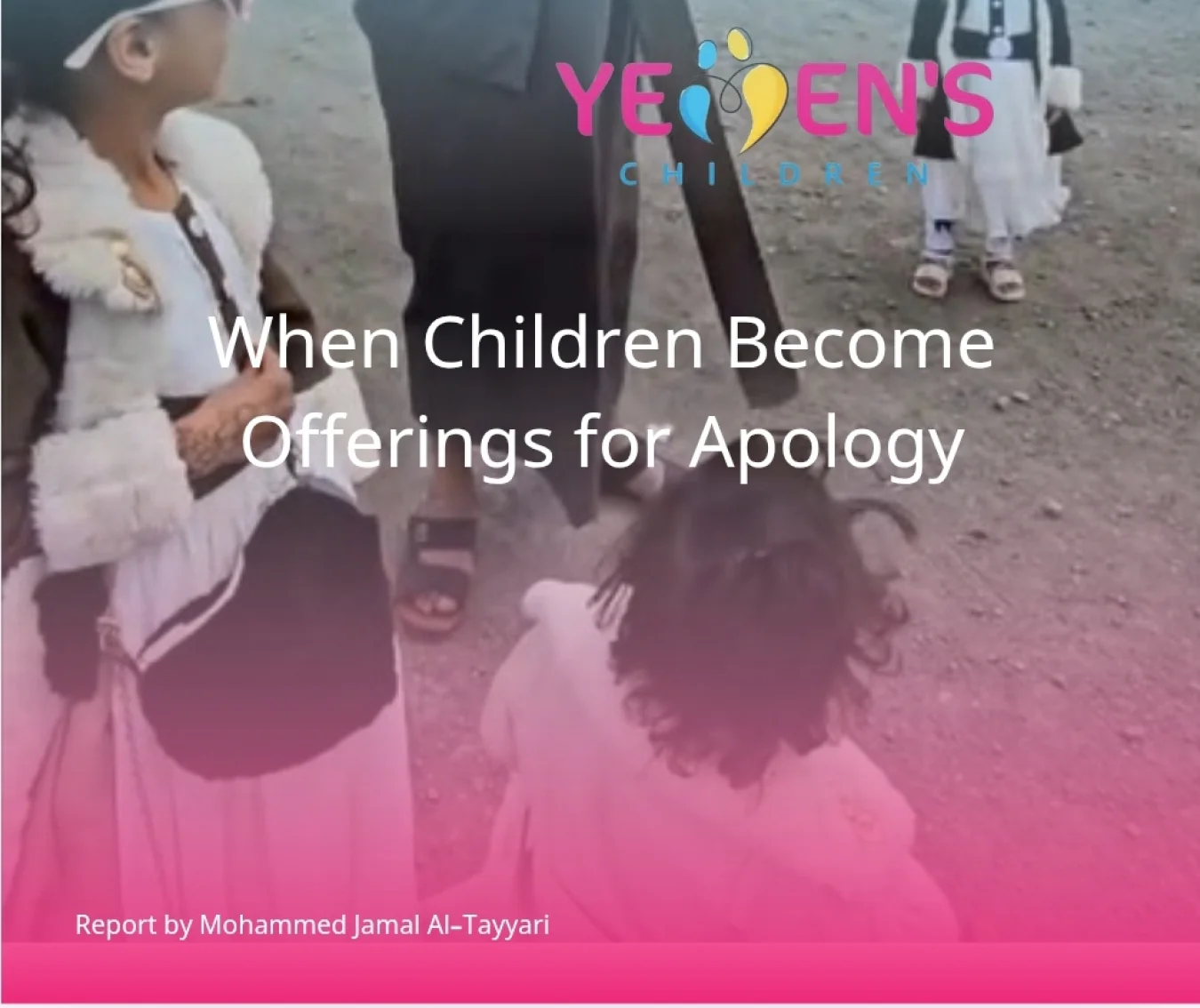
In a scene that shakes the human conscience and reveals the depth of suffering childhood can endure in the absence of compassion, three young girls were turned into symbols of a conflict they had no connection to. They were pushed into a harsh role as “hijar”—a customary practice used to settle tribal disputes—reflecting entrenched traditions in Yemen’s Dhamar Governorate.
The incident marked a painful moment in which innocence was stripped away, as children stood powerless before a group of adults, burdened with an apology for a wrongdoing they did not commit. The scene, captured in a widely circulated video, sparked widespread shock and public outrage.
The incident involves citizen Khaled Muqbel Al-Kharouqa, who sought to contain an offense he had committed against the tribes of Al-Hada, Al Bakhit, and Al Qaisi. The outcome, however, was the presentation of his young daughters as a means of appeasement within a tribal framework that included traditional reconciliation practices, but crossed a critical line when it infringed upon the dignity of children.
The girls appeared in heavy silence, their expressions marked by fear and brokenness, as though they were being forced to bear the consequences of a world far beyond their understanding. The scene encapsulated the harshness of reality when the voice of compassion is absent. The violation extended beyond childhood itself, accompanied by language and practices reflecting a degrading perception of certain social groups and professions—broadening the harm from the humiliation of children to the devaluation of human dignity as a whole. Here lies the gravity of the incident: when dignity becomes breakable, and innocence is offered as a sacrifice.
What happened constitutes an open wound in the collective conscience of society, raising a painful question: how can childhood be made to pay the price for the mistakes of adults? And how can such scenes be accepted in a society once known for protecting the vulnerable and upholding dignity?
Child Protection Is a Red Line
This incident underscores an undeniable truth: children must remain completely removed from all forms of conflict and dispute, protected from the consequences of actions they played no role in. What occurred in Dhamar—where three girls were used as hijar in a dispute—represents a serious violation of this principle, placing them in a situation that exceeds their psychological and human capacity, and subjecting them to unjustifiable pressure and humiliation under any custom or tradition.
Protecting children is an absolute moral and humanitarian responsibility. Every child has the right to grow up in an environment that safeguards their dignity, preserves their innocence, and provides security free from fear and coercion. When childhood becomes a tool for resolving conflicts, it exposes a fragile society unable to find solutions that preserve the humanity of all. No justification for involving children in such situations can stand against one fundamental truth: childhood is not a battleground for settling scores, nor a means of absorbing anger—it is a trust that must remain protected above all else.
Public Outrage and Strong Media Reactions
The incident triggered widespread anger across social media platforms, with thousands of users engaging with the circulating video, expressing shock and firm rejection of what occurred. Many emphasized that the act constitutes a blatant violation of children’s dignity and bears no relation to authentic societal values.
Amid the uproar, several journalists voiced strong positions. Journalist Ahmed Maher, in a Facebook post, sharply criticized the father’s actions, stating that he had crossed all boundaries by placing his daughters in a humiliating situation to appease conflicting parties. He also directed harsh criticism toward those present, describing the scene as an affront to childhood and a complete absence of human consideration. Maher called on Al-Hada tribes to take a clear stance to restore the girls’ dignity and uphold the tribe’s standing before public opinion. He warned that continued silence could reinforce negative perceptions, stressing that justice for the girls has become a moral necessity.
Similarly, journalist Fathi Bin Lazraq condemned what he described as degrading behavior inflicted upon the father and his daughters, calling on the tribes to issue a clear condemnation. He stressed that rejecting injustice must be a consistent and indivisible principle, and that human dignity should never be subject to compromise under any circumstances. Bin Lazraq affirmed that such incidents harm society as a whole, urging accountability and serious efforts to prevent their recurrence while safeguarding human dignity—especially for the most vulnerable groups.
Clarifications Fail to Contain Anger
Despite attempts by some parties to justify the incident, none of the explanatory statements succeeded in calming public outrage. In a video statement, Sheikh Saleh Al-Dabba explained that he was unaware of the father’s decision to present his daughters until the meeting itself, adding that the act was carried out at the father’s request to avoid threats he had received following his offense against the tribes.
In a separate recording, Al-Kharouqa stated that his intention was to “prevent escalation and strife” and protect himself from potential retaliation. He framed his actions as an attempt to avoid conflict. However, these explanations failed to ease public anger. Yemenis and social media users widely agreed that using children as a means of apology or settlement cannot be justified under any circumstances.
They emphasized that responsibility extends beyond the father to include all those who appeared in or facilitated the humiliating scene, calling for their referral to competent authorities and the enforcement of strict legal penalties. Violating children’s dignity, they stressed, constitutes both a legal and moral crime that cannot be overlooked, and justice remains the only path to protecting childhood and restoring victims’ dignity.
These demands reflect a deep public awareness that children’s dignity and safety are fundamental rights that must be protected above all else, and that Yemeni society rejects any practice that humiliates innocence or exploits children as tools in adult conflicts.
Protected Rights That Must Not Be Violated
National laws and international conventions unanimously affirm that protecting children is both a legal and moral obligation, requiring society and the state to safeguard their dignity and shield them from all forms of harm or exploitation.
In this context, the Convention on the Rights of the Child—the foremost international reference for child protection—emphasizes key principles, including the child’s right to protection from all forms of physical or psychological violence, and the prohibition of practices that undermine dignity or hinder healthy development.
The convention also stresses the need to keep children away from conflicts and disputes, and prohibits their use as tools of pressure or means of settlement, given the profound psychological consequences such experiences may have throughout their lives.
At the national level, Yemeni child protection law provides a range of guarantees safeguarding children from abuse, neglect, and exploitation, obligating relevant authorities to take necessary measures to ensure their physical and psychological well-being. The law criminalizes any act that harms a child or diminishes their dignity, including exposing them to humiliating situations or exploiting them in social conflicts.
It further emphasizes the responsibility of families and communities to provide a safe, respectful, and nurturing environment for children, free from coercion and harmful pressures.
Incidents like this place these legal frameworks under real test, underscoring the urgent need for their effective enforcement to ensure that childhood does not become a victim of customs or disputes—and that children’s rights remain a red line that cannot be crossed under any justification.