
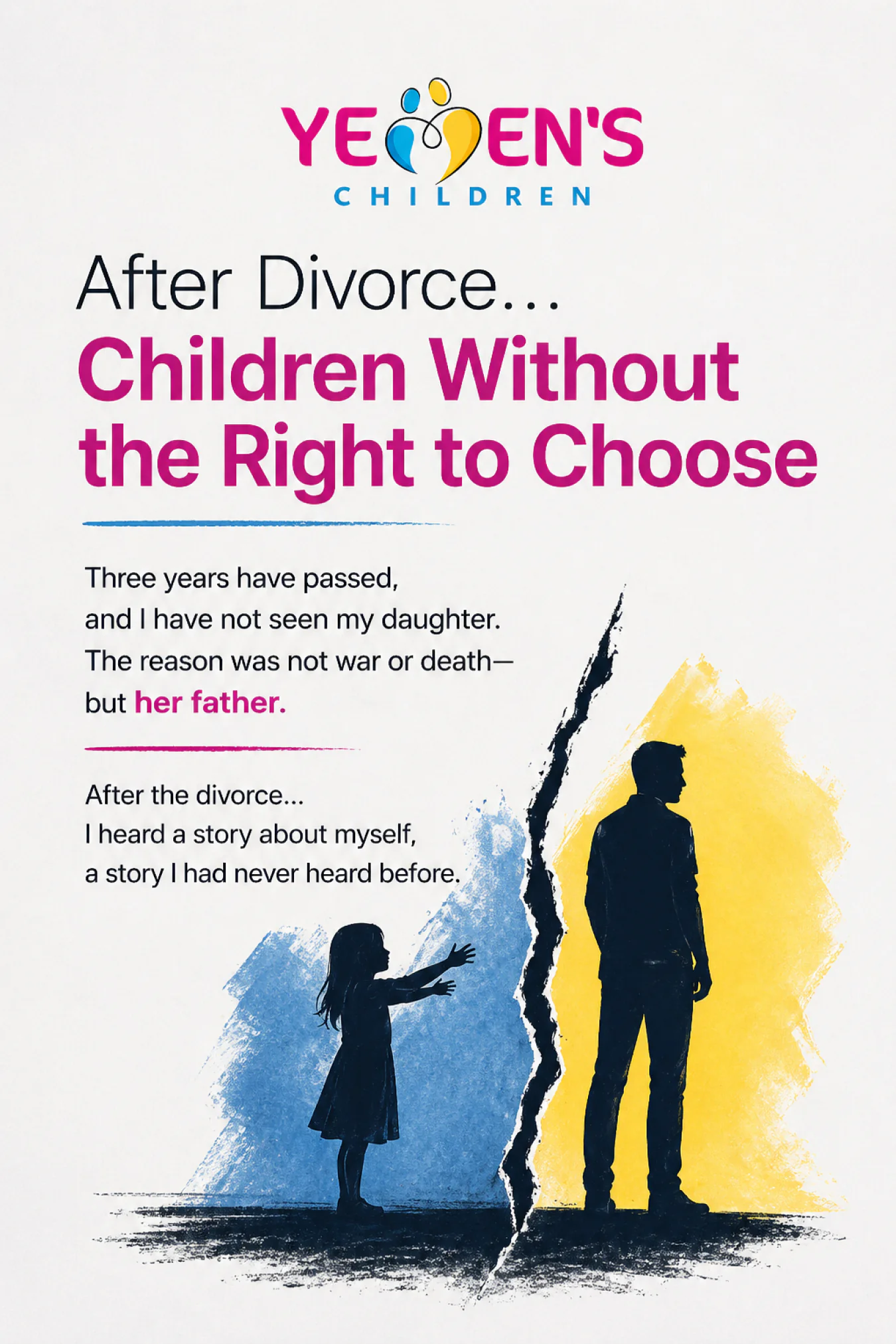
After Divorce… Children Without the Right to Choose

After Divorce… Children Without the Right to Choose
investigation _ Al-Anood Najee
“It has been three years since I last saw my daughter.
The reason was not war or death—it was her father.
After the divorce… I heard a story about myself,
a story I had never heard before.”
Souad (38), from Amran, recalls that when she requested a divorce, the father took their children and prevented them from seeing her, claiming that they did not want to. After several attempts by her family to meet the two girls, he told them that the children did not wish to see their mother. The reason only became clear when their aunt tried to meet them at school. When asked why, “Layan,” the eldest daughter, who is only 13 years old, said:
“My mother chose to leave. She didn’t love us—otherwise she wouldn’t have refused to return with my father when he went to bring her back.”
Souad adds that her daughter revealed through her conversation with her aunt that their father had told her that Souad was involved with another man, and that was why she sought a divorce and refused to return.
Many fathers use different methods to retain custody of their children, but defaming the mother in front of them is widely condemned due to its harmful impact on a child’s upbringing and psychological well-being.
Another case involves Huda (35), from Rada’a. After her divorce, she tried to reach an amicable solution with her ex-husband, as she could not afford legal fees. However, he insisted that their son did not want to stay with her.
She says: “He brought my son, but I was shocked when my six-year-old child, Luai, said he wanted his father. I asked him, ‘And me?’ He avoided answering and said, ‘I only want my father.’”
Later, she met him by chance in a park and sat with him, only to discover that his father had been keeping him through threats and intimidation. He had told him:
“If you go to live with your mother, I will go and kill her. Do you want to live without a mother?”
Along with many other threats inappropriate for a young child to hear from his own father.
The report’s author attempted to speak with one father and asked why he behaved this way. He replied that he did not want his son to be “humiliated” or to live in “other people’s homes.” When it was clarified that the child would live with his mother in her father’s house—his maternal grandparents’ home
Different methods are used, but the victim is one: the children.
Beyond being deprived of their mothers and subjected to coercion, the harm often goes further. Some mothers turned to the courts and obtained custody rulings, yet fathers found other ways. In one case, Ahmad (Amani’s ex-husband) took their daughter during his routine weekly visitation but did not return her. This placed Amani under immense pressure and forced her back into legal proceedings after she had already spent significant money securing custody. According to Article (138) of Yemeni law on family and custody matters, the mother has primary right to custody.
Maryam (25), from Sana’a, says:
“My seven-year-old son went out to buy something from the grocery store but never returned. I was terrified, especially since it had taken nearly a year and a half to obtain custody from his father. I went out searching for him but couldn’t find him. The shopkeeper told me a man had taken him. I asked if my child was forced; he said the boy went with him smiling. I realized it was his father. I called him and asked him to return the child, but he replied that the boy was his son and would only live with him. Now I am back in court again.”
Legal Perspective
Lawyer Muadh Ali explained that courts handle many cases where one parent attempts to prevent the other from seeing or receiving their children—such as claims that the mother has lost custody due to remarriage, neglect, or incapacity, or disputes over implementing custody and visitation rulings.
However, the law is clear: a mother cannot be deprived of custody without a valid legal reason, and decisions must be based on the child’s best interests—not the father’s wishes. Even if custody is legally withdrawn, the mother retains visitation rights. Any denial without a court ruling constitutes a legal violation that can be challenged.
If such denial is proven, the court may issue a compulsory enforcement order to return the child. Preventing a mother from seeing or receiving her children is a clear violation subject to enforcement by authorities.
Ali added that if an ex-husband defames the mother—whether publicly or in front of the children—the Yemeni legal system offers protections:
Crimes and Penalties Law: Criminalizes defamation, insult, and slander. The mother can file a criminal complaint.
Personal Status Law: Continuous incitement against the mother or damaging her image may indicate a lack of integrity. If the father is the custodian and engages in such behavior, the mother can request removal of custody.
He also noted that coercing or intimidating a child to choose one parent may invalidate the child’s choice. If a judge suspects the child is speaking under fear or pressure, their preference is disregarded, and specialists may be assigned to assess the child’s psychological condition.
The law prohibits any behavior that harms a child’s psychological development. Threats fall under child abuse, and Article (140) requires that the custodian be trustworthy and capable of proper upbringing.
In such cases, documentation is crucial—testimonies from neighbors, relatives, or psychological evaluations by court-appointed experts—since the judiciary relies heavily on evidence of harm.
Judicial Response
According to Yemeni law, even if custody is granted to someone other than the mother, she cannot be denied visitation rights, nor can other close relatives (Article 145). In case of disputes, the judge regulates visitation.
If a father abducts a child, this indicates a lack of trustworthiness, making him unfit for custody. Taking a child without a court order is considered a violation of legally established rights.
Similarly, removing a child from the street or forcibly taking them from the mother without judicial authorization is unlawful. The mother has the right to seek a court order for the child’s return until the dispute is resolved.
Psychological Perspective
Dr. Kawthar Al-Yamani, a psychologist, emphasizes that depriving a child of their mother—whether due to separation, divorce, or death—can leave deep psychological scars lasting into adulthood. Especially in the first five years, a child is forming their personality and emotional foundation.
The absence of the mother during this stage can lead to insecurity, attachment disorders, and long-term emotional instability.
Deliberate deprivation, neglect, or using the child as leverage between parents constitutes psychological abuse due to its emotional harm.
Al-Yamani adds that children are highly sensitive and need a stable, secure image of both parents. Hearing negative remarks about one parent—especially from the other—creates internal conflict, as the child loves both.
This conflict may distort the child’s perception, cause guilt or confusion, and destabilize emotional development. Over time, repeated negative messaging can lead the child to believe these narratives, particularly if they live with one parent exclusively. They may feel rejected or neglected, even if that is not the reality.
If divorce is not handled constructively, long-term psychological effects may include:
Anxiety and fear
Low self-esteem
Difficulty forming relationships
Social withdrawal
Emotional attachment disorders
However, if separation is managed consciously, preserving the child’s stability and relationship with both parents, these effects can be significantly reduced.
Caught between the loss of a source of security and the confusion of choosing between parents, the child lives a silent tragedy—forced to make a life-altering decision beyond their age and awareness. Yet, even then, the choice is often not truly theirs.