Khat Use Among Children: Health Risks and Early Addiction


Special Report / Tasneem Ali
Abdul Latif’s father shows little concern when he sees his ten-year-old son stuffing his mouth with fresh khat leaves however he pleases, claiming that such behavior is a sign of manhood and strong character. The boy receives his father’s words with childish pride.
Abdul Latif may seem less aware of the harm of this habit he has acquired by imitating those around him, unlike his brother Mortada (12 years old), who chews khat daily with his peers—Ali and Abdulrahman—children of roughly the same age. The three gather every evening to study together in the diwan of their rural home in Hajjah Governorate (western Yemen).
Mortada is currently in the sixth grade and says he cannot imagine his time without khat. According to him, it kills boredom, motivates him to study, and makes him more active and happy.
He adds that he faces no objection from his parents regarding his khat use as long as he keeps up with his schoolwork and achieves good grades. “My father and mother both chew khat every day. Everyone in this town does the same,” he says. “Fortunately, we own more than one khat farm, so we don’t need to buy it from anywhere.”
The Impact of Environment and Society
The phenomenon of khat use among children and adolescents is one of the most widespread habits in the eastern highlands of Hajjah Governorate, surpassing all other regions in Yemen. This is largely because khat is cultivated extensively in these climatically suitable areas, where it tops the list of crops and accounts for nearly two-thirds of the total cultivated land in the governorate.
Khat is a stimulant plant whose fresh leaves are chewed and stored in the mouth for several hours—a process locally known as takhzeen. It is an evergreen tree widely grown in Yemen. According to a World Bank report, about 90% of adult men in Yemen chew khat either regularly or occasionally (such as on Fridays), while the figure drops to around 50% among women. Among children under the age of twelve, the rate ranges between 15% and 20% of all children in Yemen—a very high proportion, representing nearly one in five children nationwide.
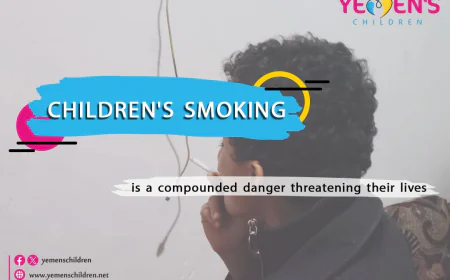
Khat use is often associated with other habits, such as cigarette smoking, waterpipe smoking (mad‘ah), and the consumption of soft drinks. Taken together, these practices severely damage health and cause numerous diseases, especially when they become ingrained habits at an early age.
In Hajjah Governorate, khat cultivation is concentrated in the highland (mountainous) areas east and south of the governorate. This has led to a sharp decline in the cultivation of other crops for which Hajjah was once known more than five decades ago, except in the northwestern lowland plains, which are hot areas unsuitable for khat cultivation, as the plant requires a relatively cool or moderate climate typical of highland regions.
Hajjah is considered Yemen’s top khat-producing governorate. The districts of Al-Sharfein and Hajour are particularly renowned for producing some of the finest khat in the country in terms of taste and effect. In the past, high-quality khat was smuggled into Saudi Arabia through the northwestern border areas of Hajjah. However, due to the ongoing war and the transformation of these areas into conflict zones, smugglers have sought alternative routes through neighboring Saada Governorate to the northeast.
Health Damage and Side Effects
Many underage khat users and school students justify their habit by claiming it helps them focus on studying and reading, complete homework without boredom, stay up late, and endure fatigue. To some extent, these claims may appear practically true, but they come with numerous side effects—health-related, economic, and sometimes social.
The health impact of khat becomes far more severe when it involves children and adolescents, especially due to the excessive and unregulated use of pesticides by khat farmers. These chemicals are often applied heavily to increase yield and speed up crop maturity, and even more dangerously, khat is sold and consumed before the safe period for pesticide toxicity to dissipate has passed. As a result, these lethal substances are transmitted directly to children and adults alike.
In a special statement, Dr. Jalal Al-Shamiri says: “Children who chew khat often suffer from emaciation, weakened immunity, and symptoms of malnutrition—among the most common diseases affecting children in Hajjah Governorate—due in part to khat use. Not to mention its effects on the nervous system, hormonal imbalance, and potentially cancer, caused by the heavy and random use of pesticides.”
He notes that while these harms affect both adults and children, they are far more dangerous for minors who are still in critical stages of growth. The same applies to pregnant women, as the impact does not stop at the mother’s health but inevitably extends to the fetus.
Dr. Al-Shamiri continues: “Addressing this issue depends primarily on parental and family awareness. When a child grows up in an agricultural environment where everyone around them chews khat, they naturally try to adapt and imitate adults. The danger lies in the widespread leniency among parents and educators in keeping children away from addiction to this plant.”
A Collective Responsibility
Many children like Mortada—who cannot imagine his life without khat and receives indirect encouragement from his parents as long as he achieves good grades—embody the deep-rooted complexity of this phenomenon. Khat use among children has become a form of social adaptation and a supposed ‘motivational tool,’ especially in environments where chewing it is seen as normal behavior or even a sign of strength.
Therefore, the responsibility to curb this phenomenon goes beyond the family and requires addressing broader societal awareness. It also demands acknowledging that this habit—into which hundreds of children slip unknowingly—constitutes a systematic theft of their childhood and their future physical and cognitive health, at the expense of building a generation capable of shouldering the responsibilities of a more mature future, far removed from the illusion of fleeting euphoria.