The Fear We Raised Our Children With

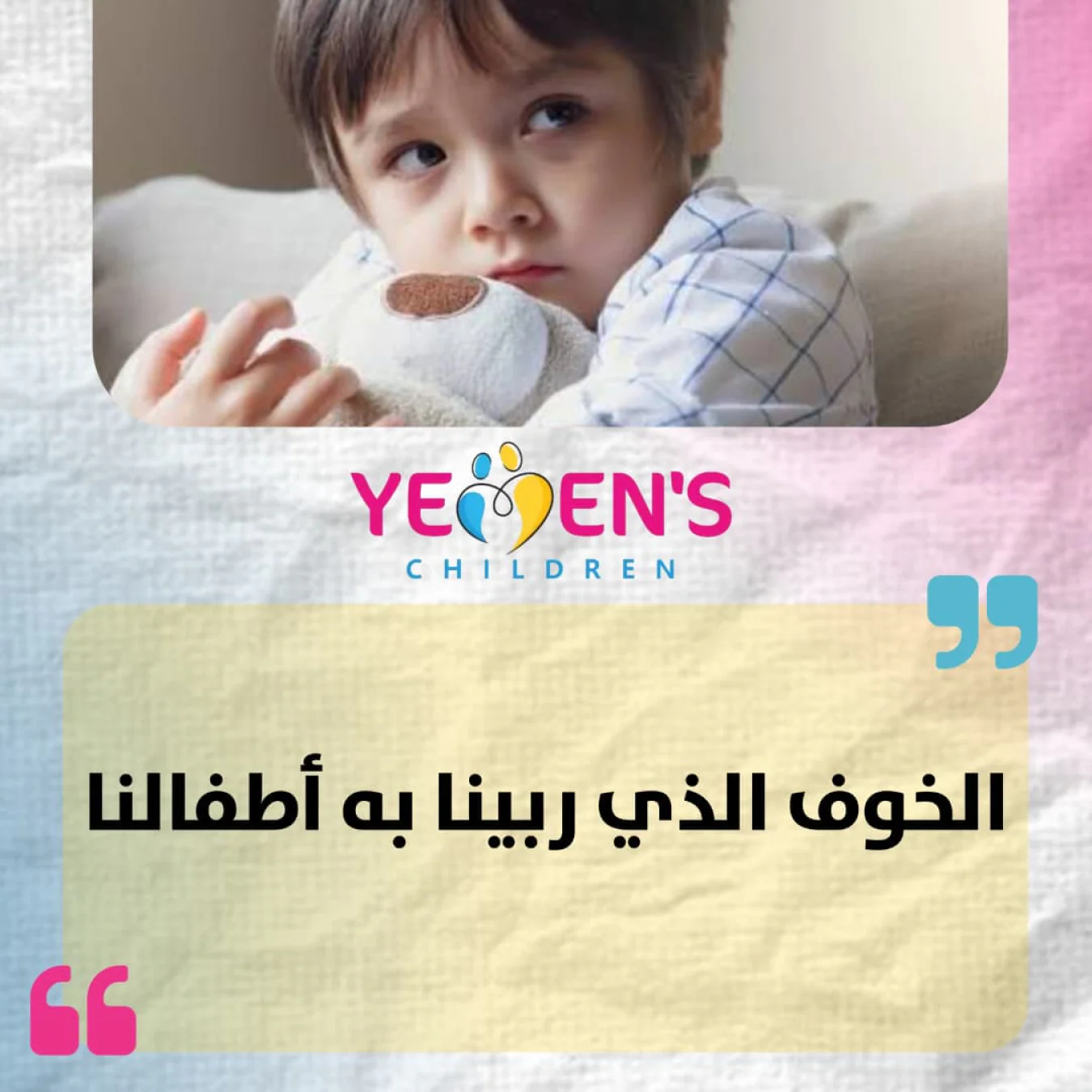
The Fear We Raised Our Children With
How did superstition turn into a parenting tool, and what has it left behind in children’s bodies and minds?
Report by / Muadh Madhesh
In many Yemeni households—especially in villages and rural areas—a child does not need to commit a serious mistake to be frightened. Raising their voice, stepping a little too far away, touching something, or going somewhere they should not is enough. At that moment, superstition appears instantly—ready, memorized, and tried before.
“The jinn,” “They’ll kidnap you,” “Be quiet or they’ll hear you and take you.”
Countless phrases and stories are told hastily with the intention of controlling a child’s behavior. No one says them out of malice; we say them because we heard them before, and they seemed to work. We fell silent, we complied, we were afraid. What we fail to see or feel at the time is that fear does not disappear—it grows with us.
Superstition That Frightens Instead of Educates
Psychology specialist Buthaina Khaled, speaking to Yemen Children Platform, believes that what happens in many families reflects a deep misunderstanding of the very concept of parenting. Instead of guidance and explanation, intimidation and lying are used as quick tools for control and reprimand. Buthaina says this approach may succeed momentarily, but it opens the door to long-term psychological and physical consequences.
She explains that parents often invent stories and imaginary creatures, or threaten children with “imprisonment” or “abandonment,” simply to force them to calm down. This fabrication and lying, according to the specialist, plant seeds of terror in a child’s mind and create a frightening world they cannot understand or confront.
The impact does not stop at fleeting fear. Over time, sleep disorders, nightmares, panic attacks, and even bedwetting begin to appear. Constant fear keeps the nervous system in a state of permanent tension, affecting cognitive and emotional development—manifesting as weak memory, emotional numbness, and an unstable personality that fears decision-making and confrontation.
Later on, this fear may turn into aggressive behavior or habitual lying. A child does not lie because they are bad; they lie because they are seeking survival—a way to escape a terrifying punishment they do not understand—using the same method they have grown accustomed to.
“Intimidation through superstition is a process of psychological ignorance,” Buthaina says. “It does not raise a conscious child; it creates a person who lives under the weight of chronic anxiety.”
A Scene from Rural Yemen: Children Fleeing Life
This story echoes clearly in reality. Activist and engineer Farida Al-Mohammadi recounts a shocking scene from one of the villages in Taiz Governorate. She says that whenever she encountered children on her way, they would scatter in every direction, running toward their homes in terror. Those who could not run fast enough due to their young age or weakness would be forced by their peers to flee by any means necessary—the important thing was that no one remained behind.
In one village, Farida entered a house to ask about the reason for this fear. She found five children hiding behind various objects in the room, screaming and crying. Farida tried to calm them, but their screams only grew louder. They were not reassured until the grandmother came out and told them in their local dialect: “Don’t be afraid, she doesn’t slaughter children.”
The painful irony, as Farida recounts, is that a five-year-old girl suggested to her grandmother that she open her chest so the child could climb inside and hide, so the kidnappers would not come and sell her heart. A child who believed her grandmother’s chest was the last safe place in a world filled with terror—based on the stories she had been warned with about strangers.
Farida links these fears to the spread of news about kidnappings and organ trafficking—many of which are rumors—yet they are told to children without awareness, turning into daily nightmares that follow them into adulthood.
When Fear Becomes a Way of Life for Children
The problem, specialists explain, is that fear does not remain tied to the original mistake. Over time, it becomes associated with life itself—with darkness, enclosed spaces, loneliness, sounds, and even questions. A child grows up afraid of things they do not know why they fear. They may grow older and forget the details of their childhood, but the impact remains, appearing as vague anxiety, fragile self-confidence, constant hesitation, and difficulty making decisions.
Superstition and the so-called “white lie” are not parenting—they are shortcuts, a rushed escape from explanation, patience, and listening. We develop a collective belief that frightening and misleading a child is easier than sitting with them and saying: this is dangerous, this is forbidden, this will hurt you or harm others.
What Are We Planting?
What we plant as fear in a child, we will reap as anxiety when they grow up. We may not see the impact immediately, but it appears later—in their fragility, their withdrawal from life, their fear of trying. Superstition may work for a moment; lying may stop a child from doing something we warned them against. But the price of all this is paid by the child alone—now and in the future. Children are a trust, and what they need, above all else, is safety and honesty. Everything else comes after.