Minister of Health Launches French-Funded Project to Build the Capacity of 3,000 Health Workers in Maternal and Child Health

Minister of Health Launches French-Funded Project to Build the Capacity of 3,000 Health Workers in Maternal and Child Health
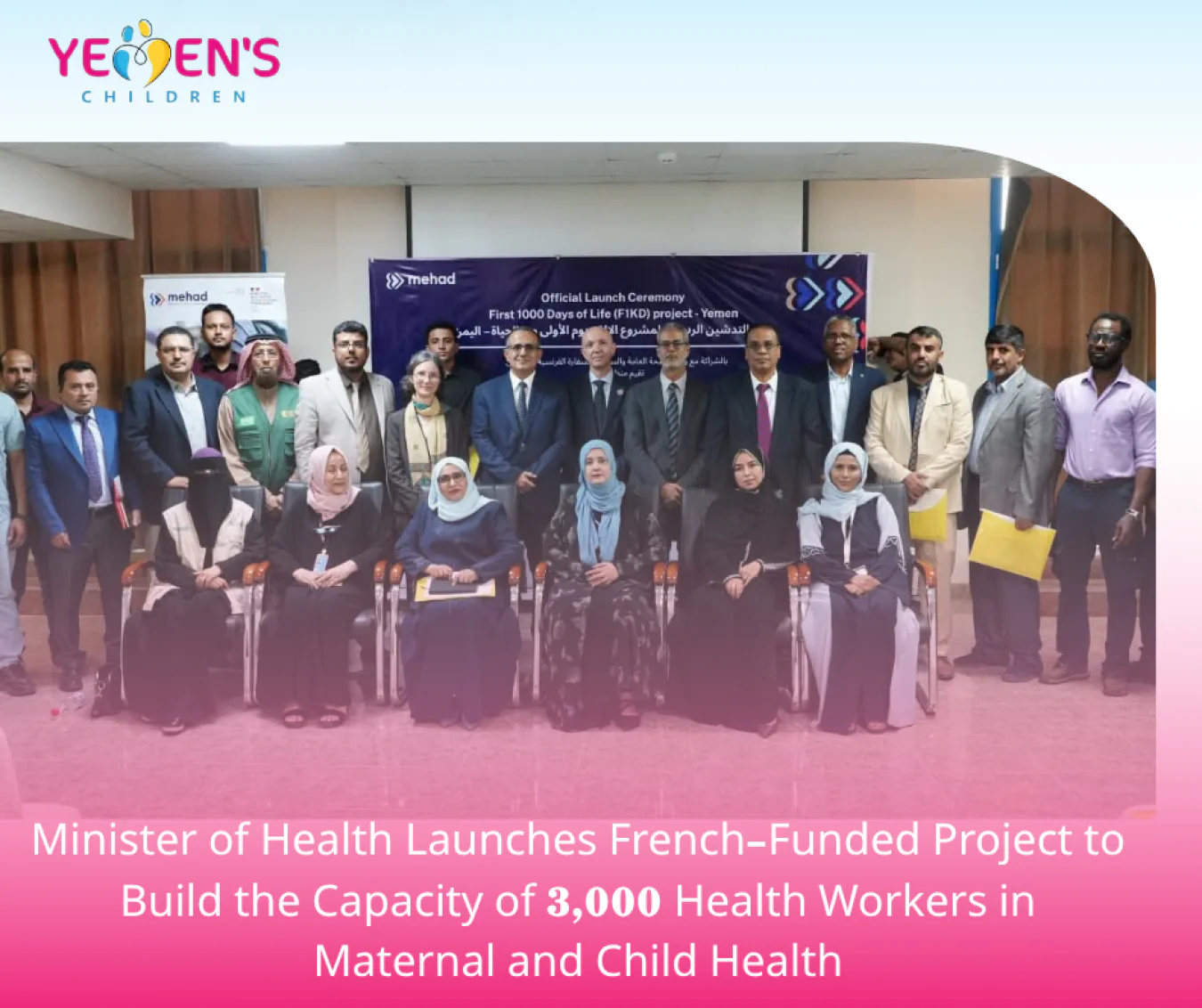
The Minister of Public Health and Population, Dr. Qassem Buhaibeh, today launched a project in the interim capital, Aden, to strengthen the capacity of healthcare workers in maternal and child health, alongside the French Ambassador to Yemen, Catherine Corm-Kammoun. The initiative is part of the First 1,000 Days of Life Project.
The 18-month project is implemented by the French organization MEHAD in partnership with the Ministry of Public Health and Population and the French Embassy. It aims to train 3,000 healthcare professionals providing primary healthcare services across the governorates of Aden, Taiz, Lahj, Abyan, Al-Dhalea, Shabwah, and Al Hudaydah. The beneficiaries include midwives, pediatricians, obstetricians and gynecologists, and nurses, with the goal of enhancing the competencies of health workers and improving the quality of maternal and child healthcare services.
The project includes the launch of an Arabic-language e-learning platform, enabling healthcare professionals to access specialized training modules. It also features face-to-face training programs, clinical simulation workshops, practical case analysis sessions, and training-of-trainers (ToT) programs to ensure sustainable knowledge transfer and broaden the impact of the project's outcomes.
Speaking during the launch ceremony, Minister Buhaibeh emphasized that developing and qualifying healthcare workers is one of the fundamental pillars of health system reform. He noted that strengthening the health workforce is a top priority for the Ministry under the National Health Strategy (2026–2030), which aims to invest in the country's health human resources and improve the quality of healthcare services across all governorates.
He stated that the project reflects the strong partnership and cooperation between the Republic of Yemen and the French Republic, demonstrating their shared commitment to investing in people and building national capacities, particularly in maternal and child health, which remains one of the health sector's highest priorities.
Dr. Buhaibeh stressed that investing in the first 1,000 days of a child's life is an investment in Yemen's future, given its direct impact on reducing maternal and newborn mortality, improving child growth and nutrition indicators, and advancing human development. He affirmed that strengthening the skills of healthcare professionals is essential to achieving these objectives.
He further noted that the project establishes a modern model for continuing medical education through e-learning and clinical simulation, while strengthening partnerships with national universities, institutes, and French scientific associations. This collaboration is expected to facilitate the transfer of international expertise and build sustainable national capacities capable of keeping pace with scientific and professional advancements.
The Minister expressed his appreciation for the continued support provided by the French government to Yemen's health sector and praised the role of MEHAD in implementing health programs. He expressed hope that the project would serve as a successful model of Yemeni-French cooperation and pave the way for further joint initiatives aimed at strengthening the country's healthcare system.
For her part, the French Ambassador to Yemen reaffirmed her government's commitment to supporting Yemen's health sector, expanding access to healthcare services, and strengthening the national health system. She emphasized that France would continue supporting initiatives that address Yemen's priority health needs.
Meanwhile, Ghazali Babiker, Head of MEHAD in Yemen, presented an overview of the organization's key interventions in the health sector and its future plans to expand its programs in partnership with the Ministry of Public Health and Population. Dr. Mervat Al-Ghallabi, the project's coordinator, also delivered a presentation outlining the project's components, objectives, implementation mechanisms, and expected outcomes.