Yemen’s Children Out of School: Childhood Caught Between Poverty and a Harsh Climate

Yemen’s Children Out of School: Childhood Caught Between Poverty and a Harsh Climate
Ruqaia Awad
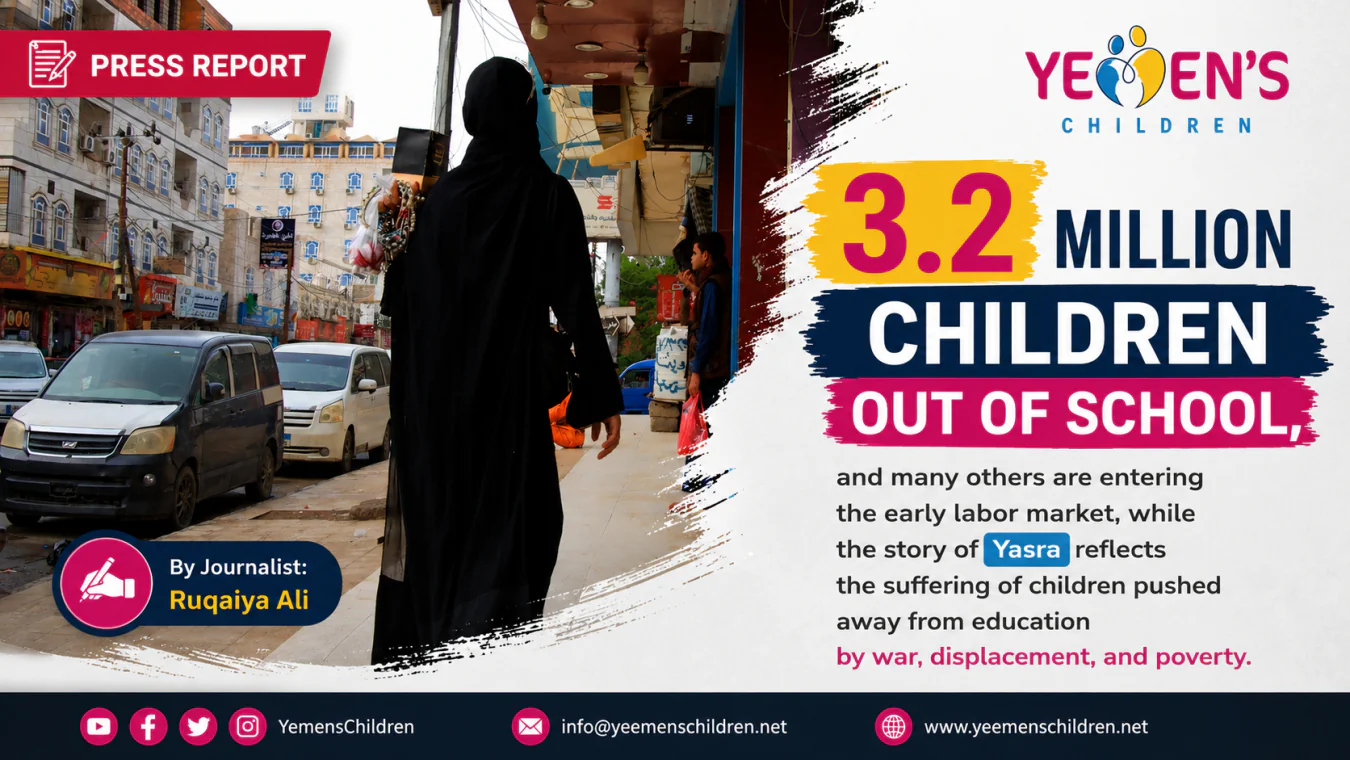
An estimated 3.2 million children are out of school, while others are entering the labor market at an early age. The story of Yusra reflects the struggles of children pushed away from classrooms by war, displacement, and poverty.
At seven o’clock in the morning, the sun in Marib has begun to send out its first waves of heat. Yusra leaves home, puts a cap on her head, and carries a collection of accessories in her small hands, along with the simple hope that someone will buy something from her that day.
She begins her day on the streets of Marib City, as she does every morning. It is a scene repeated here and across other Yemeni cities, where war, displacement, and poverty push children into the streets instead of classrooms.
In 2026, data from the United Nations Children’s Fund (UNICEF) indicate that more than 3.2 million Yemeni children between the ages of 5 and 17 are out of school, including 1.2 million children of primary-school age. Around 1.5 million internally displaced children are also experiencing disruptions to their education, increasing their risk of dropping out permanently.
Yusra is one of these children, although she does not know her place in these statistics.
At just ten years old, Yusra carries the story of a displacement that began more than seven years ago, when the war forced her family to leave Sana’a for Marib Governorate. She and her family found themselves facing harsh living conditions and rising expenses, eventually forcing her to take to the streets and work as a street vendor, like many other children pushed into the labor market by similar circumstances.
With every word Yusra speaks, a shy childhood smile appears on her face. But that smile cannot conceal the burden she carries. The effects of the sun are visible on her skin, while signs of exhaustion mingle with the dreams of a ten-year-old child.
> “I come home every evening exhausted. Sometimes I suffer from nosebleeds, rashes spread across my body, and I often get fevers,” Yusra says. She adds: “I work to support my family.”
Yusra’s household consists of her father, mother, and five children. Their situation reflects part of the hardship imposed by war and displacement on thousands of Yemeni families.
Her father, Yahya, says that before the displacement and war, he worked selling potatoes and owned a small bus that he used for work. That livelihood was enough to provide food, medicine, and shelter for his wife and five children.
But displacement changed everything.
> “After we were displaced, I became unemployed. Our expenses kept piling up, and I had no choice but to go out with my children to sell what we produce at home,” Yahya says.
Today, the family’s struggle begins with rent exceeding 280,000 Yemeni rials, equivalent to approximately 700 Saudi riyals, and continues with the costs of food, medicine, and education.
Amid this harsh reality stands Yusra, holding onto a dream that may seem simple but has become distant: a safe home and a return to school like other children.
Yusra says she dreams of having a safe home without the landlord knocking on their door, and of returning to school instead of following people through the streets trying to sell her goods.
Yusra’s story is not separate from the broader reality in Yemen. While UNICEF confirms that poverty, displacement, and the need to work to support the family are among the factors preventing many children from continuing their education, child labor remains one of the direct consequences of this reality.
In June 2026, UNICEF indicated that 12.5% of children aged 5 to 14 in Yemen are engaged in child labor, with the rate rising to 15.4% in rural areas.
For Yahya, Yusra’s father, the issue does not appear to be a choice between school and work as much as an attempt to survive.
> “It hurts me when I see the effects my children suffer from being exposed to the heat of the sun, wind, and sandstorms. But then I remember what is even worse: my fear that they will go hungry. So every day, we go out again and work as street vendors in the city to secure our daily bread,” he says.
During the summer, Yusra stands under an unforgiving sun. On other days, when sandstorms blow or heavy rain falls, nothing changes in her routine except the type of exhaustion she experiences.
Her father says extreme weather makes children’s work even more difficult, but it does not prevent them from going out. The family depends on what their small hands can earn each evening, regardless of how harsh the weather may be.
This is how Yusra’s childhood is divided among the seasons...
Medical professionals warn that children who continue working under such conditions may be exposed to heat exhaustion, dehydration, respiratory problems, and skin diseases, in addition to the long-term effects of harsh working conditions, malnutrition, and insufficient rest on their physical development.
Pediatrician Dr. Ghafourah Al-San’ani confirms that prolonged exposure to high temperatures, extreme cold, and sandstorms negatively affects children’s health. The effects can range from elevated body temperature and skin problems to respiratory infections that may leave chronic consequences when exposure to such conditions continues for many years.
She adds that harsh working conditions, combined with malnutrition and inadequate rest, affect children’s growth and physical development and increase their risk of injuries while working on the streets.
All of this comes while symptoms such as the nosebleeds and skin rashes described by Yusra may appear to some people to be merely temporary fatigue. But for a child who spends hours of every day on the streets, exhaustion does not end when the working day is over.
In a country where war, displacement, and poverty continue to push millions of children away from education, Yusra’s wish to return to school appears to be more than a child’s dream. It is an attempt to reclaim a part of her childhood taken away by displacement and hardship.
Humanitarian observers believe that reducing child labor cannot be achieved simply by removing children from the streets. It requires addressing the circumstances that pushed them there by providing economic support to families and alternative sources of income, while ensuring children’s return to education and access to protection and healthcare—particularly amid the harsh climatic conditions they face while working.
Observers also emphasize the need for government authorities, international organizations, and local organizations to expand social protection and cash assistance programs, support education, and help children who have dropped out return to school. They also call for mechanisms to monitor the conditions of working children and protect them, helping families overcome the circumstances that have forced their children into the labor market.
As Yusra’s story makes clear, protecting childhood does not begin only on the streets. It begins with families having the means to live without relying on the small hands of their children.