Bahá’í Children in Yemen: An Impact That Extends Beyond Prison Walls

Bahá’í Children in Yemen: An Impact That Extends Beyond Prison Walls
Islah Saleh
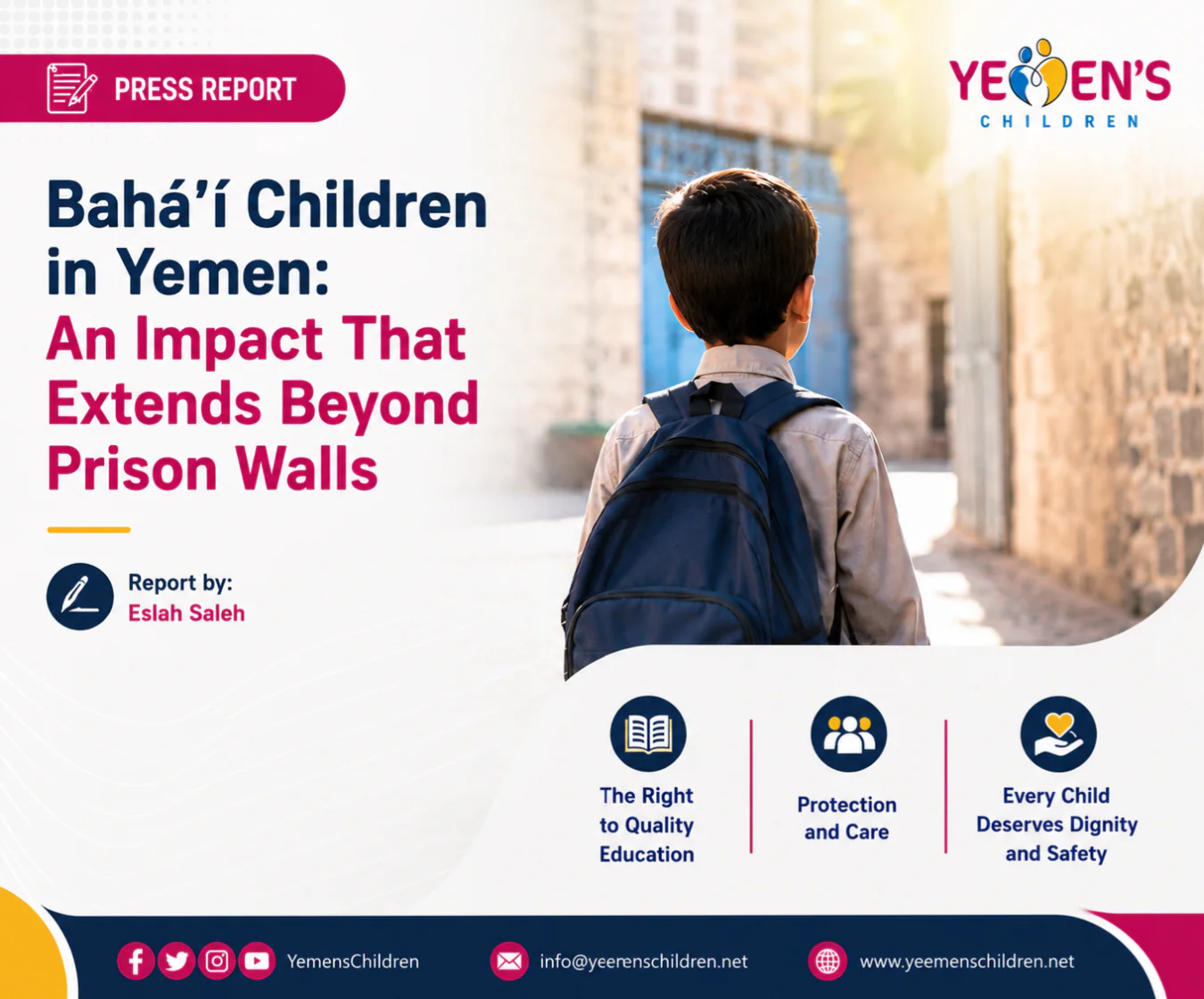
“R.L.,” an eleven-year-old boy, did not realize that his father’s abduction and the spread of news about his arrest because of his family’s Bahá’í faith would change his childhood forever. What began as fear for his father soon extended into his daily life. At school, the classroom walls transformed from a space for learning into an arena for bullying and comments from classmates, while the looks of his friends in the neighborhood deepened his sense of being different. Eventually, he began withdrawing from school and play. In the end, his family decided to leave, packing up what remained of his childhood and leaving the country in search of the safety they could no longer find.
R.L.’s story is not merely an isolated incident. It represents a broader reality experienced by Bahá’í children in Yemen. When a parent is arrested because of their beliefs, the impact does not remain behind prison bars; it extends into the home, the street, and the school.
Over recent years, areas under Houthi control in Yemen have witnessed widespread arrest campaigns targeting Bahá’ís, including women and children. Raids and persecution of Bahá’í gatherings have been repeatedly reported, along with threats, detention, confiscation of property, and restrictions on religious practice and community activities. In some cases, these pressures have forced families to relocate or, in the most difficult circumstances, leave the country. The consequences have also extended to children, who find themselves facing repercussions for circumstances they did not choose.
The mother of R.L. says that what her son experienced was not the result of a single incident, but rather a series of accumulated experiences that began after his father’s arrest and the spread of information about the family’s religious identity. These experiences later affected his life at school and within his social surroundings.
She explains that the family became particularly concerned when her son’s behavior began to change. He no longer wanted to go to school or play with other children and increasingly preferred to stay at home. Eventually, the family felt compelled to leave Yemen.
She emphasizes that the decision to leave was not primarily a search for a better life, but an attempt to spare him his father’s fate and provide an environment where her child could feel safe and live and study without his family’s identity becoming a reason for him to be harmed or isolated.
Children in Detention
The consequences of persecution are not limited to children who have witnessed the arrest of their parents. A source familiar with the situation of Bahá’ís in Yemen confirmed that children were also among those detained during campaigns targeting Bahá’ís.
However, the limited number of such cases makes it risky to discuss the details of their experiences, as even information shared without names could potentially reveal their identities. For this reason, those concerned preferred not to share their stories.
The source adds that other children have experienced the consequences of arrest from outside detention facilities, after witnessing raids on their homes and the arrest of their fathers or mothers. In some cases, they were intimidated or threatened with suffering the same fate as their parents. They later endured the anxiety of waiting or visiting a detained parent.
According to the source, these experiences represent an aspect of violations that is often absent from documentation, despite the potentially profound impact they can have on children’s sense of safety and psychological well-being.
Behind the Walls of Trauma
The family of “A.S.,” a ten-year-old girl, recounts a similar experience. She experienced moments of terror following the arrest of both her parents and remained with her younger brother in the care of their grandparents.
According to the family, this experience turned the sound of a knock on the door or a ringing bell into a constant source of anxiety associated with the possibility of another raid. The experience led to sleep disturbances and a decline in her academic performance, while her younger brother became less communicative as a result of the trauma.
Bahá’í families have faced the challenge of explaining this reality to their children in a truthful yet simple way. They adopted an approach aimed at protecting children from feelings of shame or desires for revenge.
A.S.’s mother explained to her that her father’s arrest “was not because he had done something wrong, but because of his service to the community and his beliefs.”
According to the family, the goal was to promote positive resilience by helping the child understand that differences in belief do not have to lead to conflict, but can instead encourage continued service and coexistence despite injustice.
An Impact That Does Not End With Arrest
Psychologist Dr. Iman Lotf Al-Buraihi believes that the arrest of a parent “shakes one of the child’s most important sources of security. A child needs to see their parents as capable of protecting them and to feel that home is a safe place. In some cases, the child may continue to experience fear even after the parent returns, particularly if they do not understand why the arrest occurred or if they witnessed the raid or detention, or observed the fear experienced by the family.”
Al-Buraihi adds:
> “Another important issue is when a child feels compelled to conceal their family’s religious affiliation because of fear of stigma, discrimination, or harm. When a child feels that part of their identity must remain secret in order to stay safe, they may experience an internal conflict between their identity and their need for acceptance and protection. Over time, this can affect their trust in others and their sense of being able to be themselves without fear.”
However, she emphasizes that such experiences do not necessarily mean that a child will develop a permanent psychological disorder. The presence of a supportive family, a trusted adult, and a safe school environment, along with honest explanations appropriate to the child’s age, can help restore their sense of safety.
The Right to Be Different
According to Nader Al-Saqqaf, Director of the Public Affairs Office of the Bahá’ís in Yemen, the consequences of arrests within the Bahá’í community are not limited to children who directly witness the arrest of their parents.
Some Bahá’í families have been forced to change their places of residence or withdraw their children from school for periods of time, fearing that authorities might locate wanted parents by monitoring children as they travel to and from school.
According to Al-Saqqaf, Bahá’í families have not encouraged their children to conceal their religious identity. Instead, they have emphasized that faith is a personal matter and that differences in belief do not diminish a person’s citizenship or rights.
Nevertheless, this has not prevented some children from being subjected to offensive comments or forms of bullying, which families attribute to a lack of knowledge about the Bahá’í faith.
In response, families have sought, according to Al-Saqqaf, to ensure that children’s pride in their identity does not turn into confrontation with others, but instead into an understanding that religious differences are part of the diversity of Yemeni society.
He stresses that the continued presence of Bahá’ís in Yemen, despite the pressures they have faced, reflects their commitment to remaining part of their society and contributing to its service, rather than allowing their religious differences to become a reason for their exclusion or forced departure.
Legal Text Without Protection
Yemen does not have a specific law dedicated to religious minorities. However, Article 9 of the Child Rights Law No. 45 of 2002 states that children are entitled to the rights, freedoms, protection, and care guaranteed by applicable laws without discrimination on the basis of sex, color, or belief.
Yet the stories documented in this report reveal a gap between the rights guaranteed by law and the reality experienced by some children.
According to Walid Saleh Ayash, Secretary-General of the National Council for Minorities in Yemen, the issue of Bahá’í children goes beyond a single religious community and represents “a real test of the meaning of citizenship and human rights in Yemen.”
He says that forcing a child to bear the consequences of their family’s beliefs may lead them to grow up feeling that their identity makes them less accepted and less entitled to equal rights within society. It may also push them to conceal their identity and feel alienated within their own country.
Ayash warns that teaching children that religious differences are grounds for exclusion plants the seeds of future conflicts. He calls for strengthening equal citizenship, protecting freedom of belief, removing hate speech from education and media, and building a culture that sees diversity as a source of richness rather than a threat.
He summarizes this by saying that protecting children belonging to religious minorities is not merely about protecting one particular group, but about protecting Yemen’s future itself.
What the Numbers Do Not Count
The full scale of the impact of persecution on Bahá’í children remains difficult to measure. According to the Director of the Public Affairs Office of the Bahá’ís in Yemen, there are no accurate statistics documenting the number of children who have left school or been forced to change their place of residence because of persecution.
Among the reasons for this, he says, is the difficulty of obtaining accurate information about the Bahá’í community itself, given the risks associated with revealing religious identity.
Al-Saqqaf notes that thousands of Bahá’ís continue to live in Yemen across different cities and governorates, despite the difficult conditions and the arrests, persecution, threats, property confiscation, and restrictions on work, worship, and community activities they have faced over recent years. Families who have been forced to leave the country represent only a limited portion of the community.
Amnesty International reports that it has documented the arrest of at least 100 followers of the Bahá’í faith in Yemen by Houthi authorities since 2015, including 65 people arrested in August 2016, among them six children. In May 2023, 17 Bahá’ís, including five women, were arrested.
In another form of repression, a court operated by Houthi authorities in Sana’a sentenced Bahá’í prisoner Hamed bin Haydara to death in January 2018. The Court of Appeal upheld the sentence in March 2020. Days later, the head of the Houthis’ Supreme Political Council announced a pardon for him and the release of Bahá’í prisoners. Bin Haydara was released in July of the same year along with five other Bahá’ís, on the condition that they leave Yemen, according to UN documentation.
Behind the arrest figures are children whose names do not appear in official data and whose experiences cannot easily be measured: a child who lost access to school, another who was forced to change where they lived, and a third who learned that concealing their identity might be safer than revealing it.
In the case of R.L., the story did not end with his father’s arrest. It extended into the school and the street, and eventually ended with a suitcase.
While the number of detainees can be documented, it is far more difficult to count what children have lost behind those numbers: their sense of safety, their education, their relationships, and their confidence that they have a place in their own homeland.