“Latchkey Children” Between World War II and the War in Yemen

By journalist Moaz Madhesh
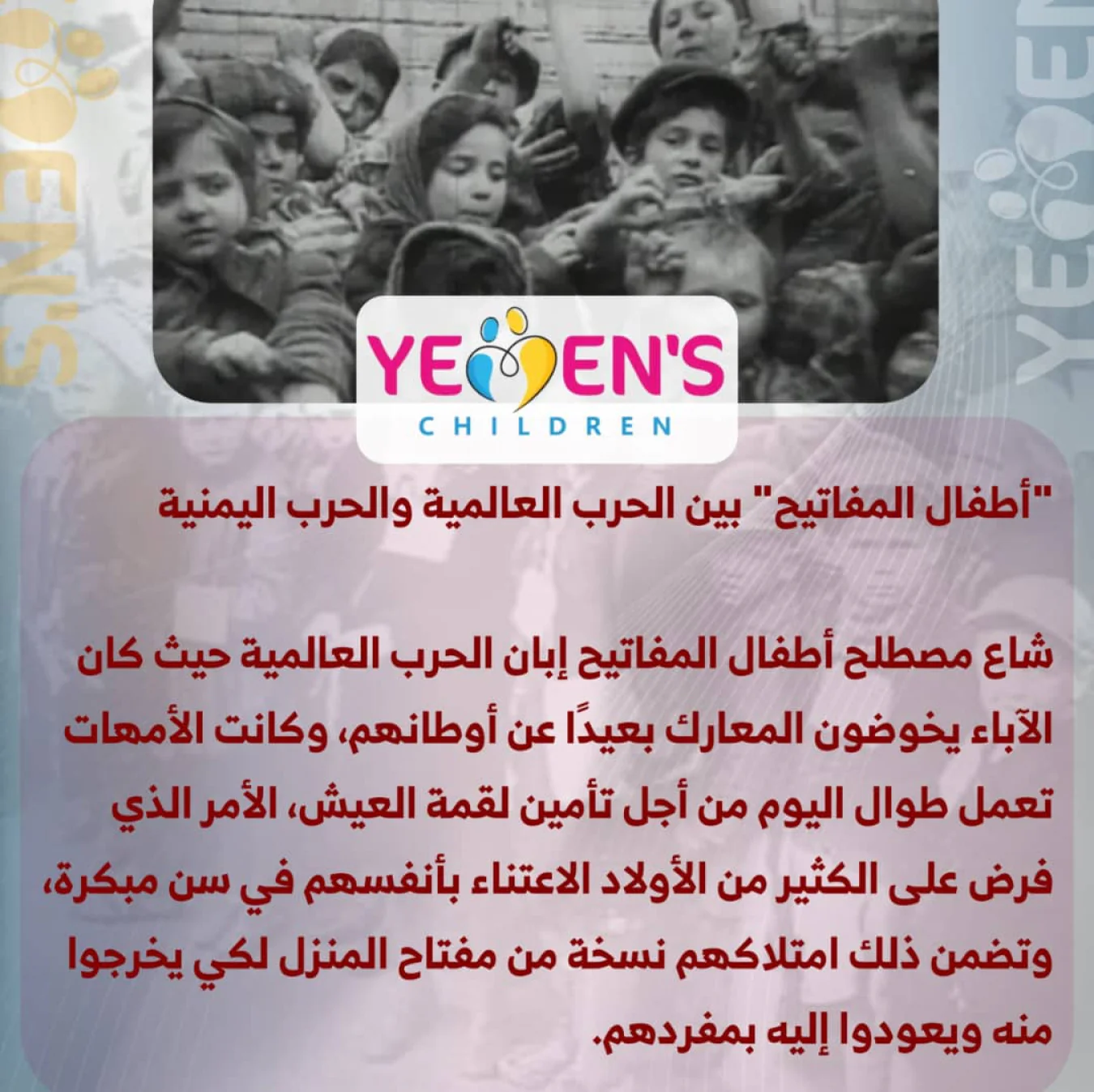
The term “latchkey children” became widespread during World War II, when fathers were fighting battles far from their homelands and mothers worked all day to secure a livelihood. This reality forced many children to take care of themselves at an early age, including carrying a copy of the house key so they could leave and return home on their own.
Today, the term is generally used to describe children who bear responsibility for caring for themselves because their working-class parents are away from home during the day. As for the children of Yemen—those who have been living on the streets day and night since the outbreak of war, without a home or shelter, stranded by circumstance—nothing remains for them in the country but a scorching sun that proves their Yemeni identity by day, and torn cardboard boxes that shelter them at night.
Between the Impacts of War and the Risks of Child Labor
“Ghada,” 13 years old, is from Hajjah Governorate. The war, along with her four siblings, forced her family to flee to the city of Aden four years ago. Every day, Ghada stands at Cairo Roundabout in Aden from morning until 8:30 p.m., holding soap in one hand and a squeegee in the other, wiping dust off cars so drivers will notice her. She did not tell us that the bandage on her left hand was caused by an angry driver who struck her after she cleaned his car without permission. Her brother Abdullah told us that.
The only difference between Ghada and Abdullah, who is nine years old, is that he sells tissues. The moment you see him, his features stop you and raise dozens of questions in your face: Until when? Is there a solution? If one comes, what will their future be? The answers are absent, leaving only one bitter consolation—that no one in the country needs tissues more than their seller, Abdullah.
Harsh Paths
Ghada and Abdullah are a microcosm of the impact the war in Yemen has had on children—a model representing a large segment of minors found on the streets, either washing cars or selling items that barely keep them alive. Some have taken paths that are both easy and harsh at the same time, such as begging or collecting empty containers to sell in the plastic recycling market. Despite the different ways they earn a living, they share the same age group and carry the same features—features that resemble war.
Deprivation of the Right to Education
To recover and limit the consequences of war on children, a sociologist, a street vendor, and an ordinary person alike will all tell you the same thing: education is the lifeline. In Yemen, children of school age make up nearly 33% of the total population. More than two-thirds of these children live in remote areas that are difficult to access, which limits their ability to reach educational institutions.
Recent UN reports state that more than 4.5 million Yemeni children were not enrolled in school in 2023, while over 2,426 schools were damaged and became unable to receive students due to being used as shelters or for non-educational purposes. The longer students remain out of school, the harder it becomes to compensate for learning loss, with ripple effects across entire communities.
An Unsafe Childhood
These are small snapshots of children who do not grow up gradually. War races ahead of their years, pushing them onto the streets before they even learn the way to school. Ghada, Abdullah, and countless other children are not exceptions; they are a mirror of an entire generation learning how to survive instead of memorizing multiplication tables—a generation that counts its days by the number of passing cars and the number of violations it endures, violations that have nearly become routine in their lives.
Amid all this, while figures pile up in organizational reports, the most important question remains suspended in the eyes of these young ones:
Will there come a day when the Yemeni child is just a child—without a key, without a street, without war?