Yemen’s Children: Victims of Drowning

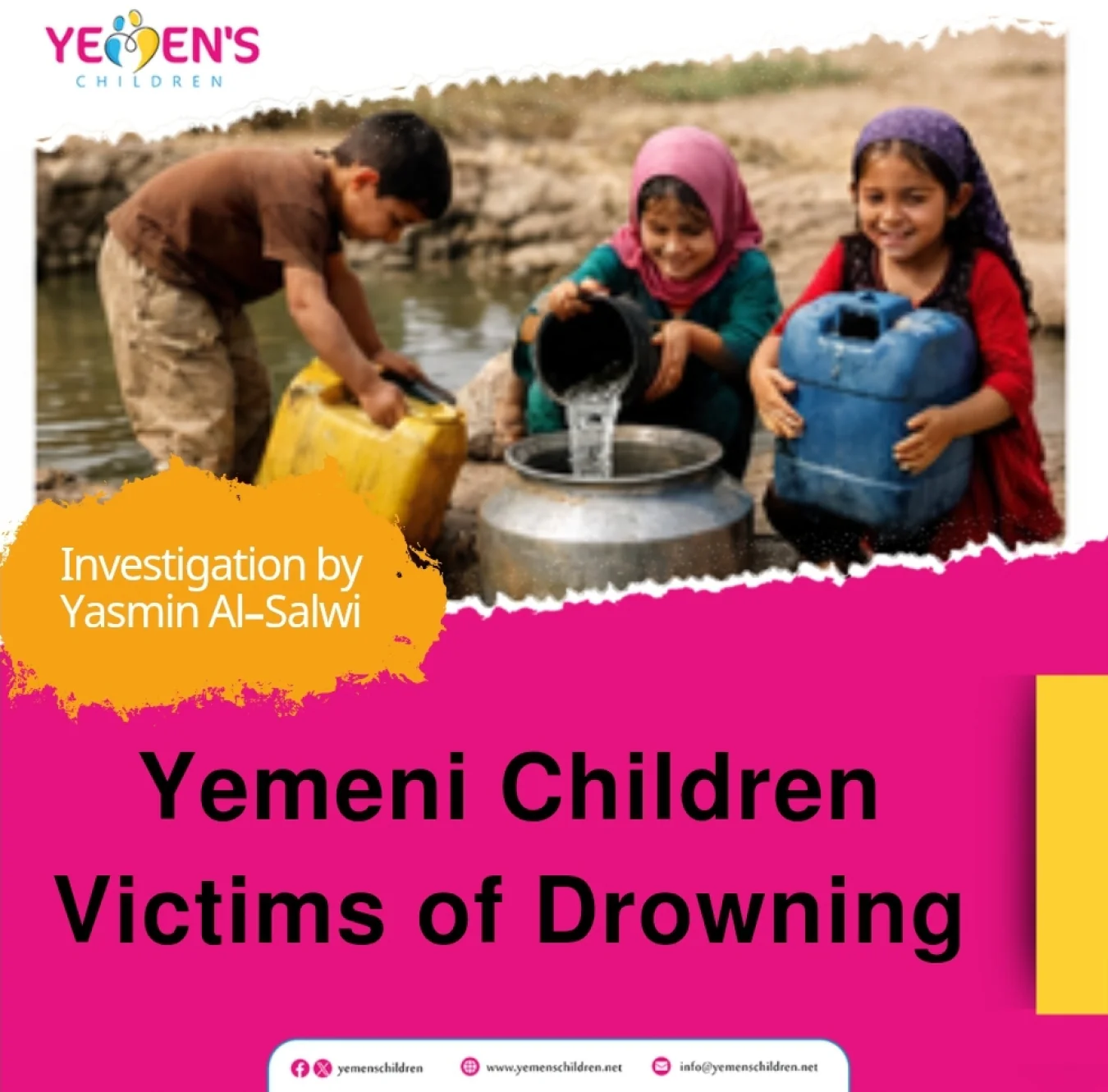
Investigation: Yasmin Al-Salwi
Ali Rashid, 30, from rural Rima in western Yemen, still recalls many details of the drowning of his nine-year-old brother, Ahmed, in an open water pond next to a village mosque, despite the time that has passed.
Ali told Yemen’s Children platform: “Next to the village mosque is an open water pond. One afternoon, Ahmed went to the mosque for Asr prayer as usual. Several children were playing near the pond. According to eyewitness accounts, he tried to catch a ball that had fallen near the edge of the pond, slipped, and fell, with no one nearby to save him. The weather was very cold, which worsened his condition and led to immediate drowning.”
He continues bitterly: “What is even more painful is that the day before the incident, Ahmed had achieved first place in his first-grade class, and a small school celebration was planned for him. He went out to perform Asr prayer and return quickly to share his joy with family and friends, but his joy was destined to be in Paradise, God willing.”
Similar incidents occurred in Mazhar District, in Al-Marfadi village, where eight-year-old Ayman Al-Maksh died after falling into a mosque pond. Another drowning occurred in Al-Huqul village, Bakal area, Mazhar District, where two sisters fell into an open pond next to their home. While fetching water, one slipped and nearly drowned; the other tried to save her and also drowned, and both died together.
Many Yemeni villages rely on ponds and water reservoirs filled with rainwater, as water projects are lacking. Villagers use these ponds for daily water needs, especially given the rough terrain and scarcity of natural water sources like springs and wells, putting children at risk of drowning.
In addition, fetching water is a daily responsibility of women and children in many rural areas, increasing their exposure to drowning hazards, particularly when using open ponds and reservoirs. Repeated incidents are recorded annually, often involving children, due to lack of safety measures and infrastructure.
Similar Tragedies
Child drowning incidents are not limited to Rima; similar tragedies occur across Yemen. Local media reported the drowning of three children in December of the previous year in a rainwater pond in Shaab Naba, Al-Khokha District, northern Hodeidah; three children were rescued in the same incident.
Drowning incidents are also reported in Al-Mahwit Governorate, where three girls died in a rainwater pond in Beit Al-Jabri village, Bani Al-Badi area. The victims were Dalal Raed Saleh Hizam Al-Jabri (11), Rumooz Sultan Ahmed Hizam Al-Jabri (8), and Raghad Khaled Ahmed Al-Sabbak (9).
Ongoing Incidents
On Thursday, August 29, 2025, four-year-old Ayat was playing near her mother in their home in Mazhar District, Bakal, Rima Governorate. While her mother was busy with housework, Ayat went missing. Her family searched inside and outside the home and asked other children, but found nothing.
Her grandfather, Qasim, said: “While everyone was searching, including other children, they noticed her dress floating on the water. Some villagers tried to pull her out, only to discover she had drowned. We immediately took her to the health center, but she had already passed away.”
In Taiz, five-year-old Nada Ahmed was found floating in a sewage pit after villagers searched for her for two days. A local woman spotted her while grazing sheep nearby. According to villagers, Nada had gone to the terraces looking for her mother, who had gone to fetch animal feed, and disappeared that morning.
Expert View
Mohammed Al-Khudairi, head of the Nidal Human Rights Organization in Yemen, says that the rising trend of child drowning is due to family negligence, lack of protective fences, and absence of swimming education. He stressed: “Preventive measures include teaching children to swim, supervising them, building ponds with safety measures, and installing secure systems for wells and deep pits, as well as using pumps to deliver water to external tanks instead of manual scooping.”
Global Perspective
According to the World Health Organization, drowning is a global public health problem, causing around 300,000 deaths annually. Children and youth are disproportionately affected. Children under five account for about a quarter of drowning deaths. Drowning is the fourth leading cause of death for children aged 1–4, and the third leading cause for ages 5–14. Approximately 92% of drowning deaths occur in low- and middle-income countries, highlighting the urgent need for preventive efforts.
Rima: The Hardest Hit
Rima Governorate is among the poorest regions, where residents have lived for decades without basic services. The state has neglected the area, forcing locals to provide essential services themselves, including roads and water projects. Despite a government water project in the district center, it often halts due to fuel costs, leaving many to transport water manually.
Traditional Pond Construction in Rima
Faiz Al-Dhubibi, head of Rima21 platform, explained that local water needs are critical due to agriculture and livestock. Efforts focus on digging wells and building ponds and barriers to store summer and autumn rainwater, repeatedly transporting it to homes by children, women, and donkeys.
These ponds and barriers are often open and wide due to mountainous terrain, built using traditional methods without safety measures, and located far from villages. Children and women travel long distances to collect water and carry it home, often without any protective systems. Many children cannot swim, making them highly vulnerable to drowning accidents.
Al-Dhubibi emphasized that such conditions cause many women and children to drown yearly in Rima’s wells, ponds, and barriers due to depth, lack of safety, and limited swimming skills. He noted that the issue has been longstanding, documented by parents and grandparents, and social media has recently brought it to wider attention.
Community Efforts
Inspired by personal tragedy, locals like Rashid Al-Bakali converted ponds that claimed loved ones into safe spaces for teaching swimming. In Bakra village, Salouh, Taiz, citizens like Mahyoub Mohammed bought portable pools to teach village children to swim safely, providing alternatives to dangerous open ponds.
These initiatives aim to reduce repeated drowning accidents, ensure children’s safety, and provide sustainable water access alternatives for the community.